
SE00255
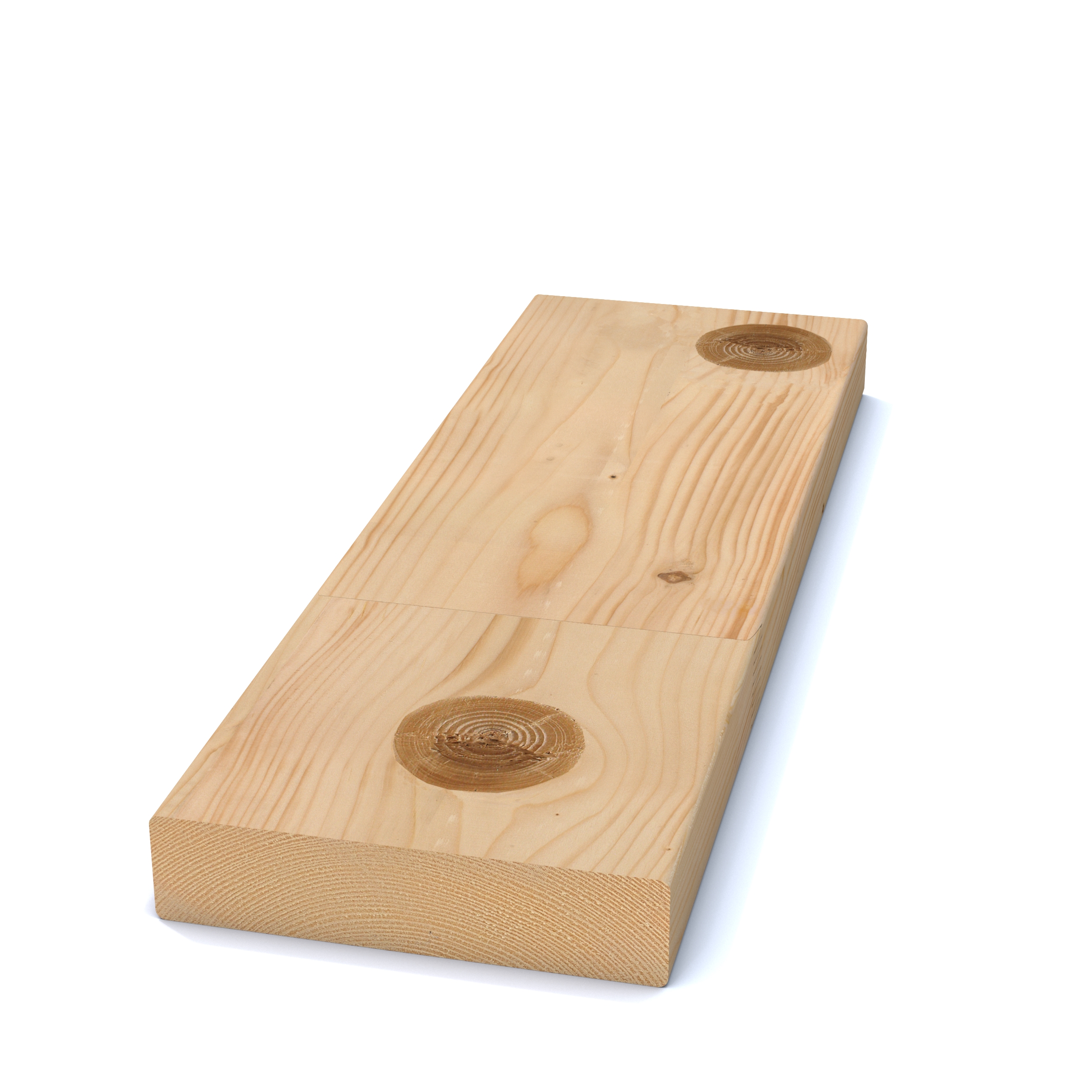
Finger jointed structural timber C14 Spruce Untreated 45x195
For use in buildings and bridges. finger jointed structural timber has a glued longitudinal joint designed with finger-like wedges.
The jointing is carried out industrially under controlled conditions. Product standard: EN 15497 Structural finger jointed solid timber - Performance requirements and minimum production requirements.
Properties
| Swedish Wood - ID for generic product type | SE00255 | ||
Swedish Wood - ID for generic product types, which are included in the Swedish Wood standardised product assortment. |
|||
| VilmaBas-ID | VB1815 | ||
Identity used by Swedish building material dealers |
|||
| Product category performance standard | EN 15497 - Structural finger jointed solid timber | ||
A National (SS) and/or European (EN) performance standard for the product category. Contains specifications about a product's characteristics, attributes, design and test methods. A harmonized performance standard (hEN) is a European standard (EU) developed on behalf of the European commission (EC). |
|||
| Performance declared and CE marked according to the European Construction Products Regulation (CPR) | Yes | ||
For a construction product, which is covered by a harmonised standard (EU) and is sold on the EU internal market, a declaration of performance and CE marking are mandatory. Construction products that are not covered by a harmonised EU standard can be declared for performance and CE marking on a voluntary basis. The manufacturer can then contact a Technical Assessment Body to request a European Technical Assessment (ETA). Read more European Organisation for Technical Assessment (EOTA) |
|||
| Wood species - English name according to EN 13556 | Spruce | ||
English name for the botanical/latin name and designation in EN 13556 |
|||
| Wood species - botanical name according to EN 13556 | PCAB - Picea abies | ||
The Latin name and a 4-letter code used in Europe. |
|||
| Strength class according to EN 338 (C classes) | C14 | ||
C-classes for softwood that provide information about the strength and stiffness properties of the material Read more Swedish Wood - Wood grades |
|||
| Dry graded structural timber according to EN 14081-1 | Yes | ||
Declares whether the wood has been dried and its sorting has been completed. |
|||
| Sorting method according to EN 14081-1 | Machine | ||
Declares whether the structural timber is mechanically or visually sorted. |
|||
| Profile type according to Swedish Wood specification | Planed timber | ||
Wood can be processed into different profiles with different appearances and uses. For example, different forms of sawn, planed, grooved sides and edges. Or milled grooves and rebates for joining, and more. |
|||
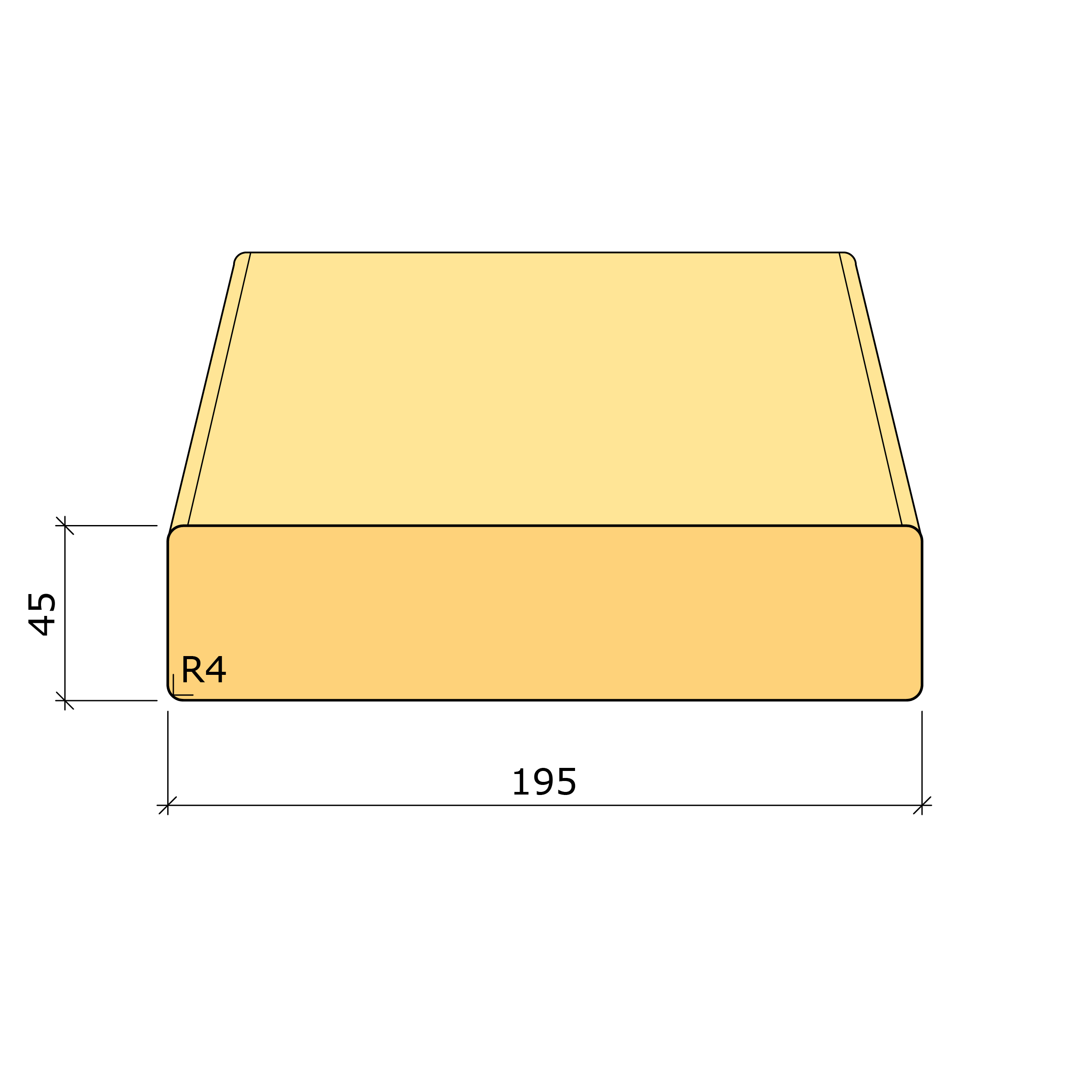
| Surface structure according to Swedish Wood specification | Four planed sides with four rounded corners, radius 4 mm. | ||
The different side and edge surface structures for a profile type can be produced to meet different technical and appearance requirements. For example, with different techniques and equipment for sawing, planing, grooving and grinding. |
|||
| Thickness according to EN 1309-1 | 45 mm | ||
Thickness measured in a direction perpendicular to the surface, in at least three places |
|||
| Width according to EN 1309-1 | 195 mm | ||
Width measured in a direction perpendicular to the longitudinal axis, in at least three positions |
|||
| Covering width, assembled, according to Swedish Wood specification | 195 mm | ||
The visible width, for example of an individual tongued or grooved board after assembly. |
|||
| Timber consumption per square meter according to Swedish Wood specification | 5,13 rm/m² | ||
For calculating the number of running meters (rm) per square meter (m²) (excluding waste). Based on the product's covering width. |
|||
| Profile area, taking into account design, according to Swedish Wood specification | 0,08775 m² | ||
Calculated on the actual profile of the wood product.
For example, the area of a tongue-and-groove profile needs to be calculated taking into account the tongue-and-groove design. |
|||
| Target moisture content according to EN 14298 | 16 % | ||
The concept of target moisture content describes the desired average moisture content when delivering a batch of wood. Read more Swedish Wood - Wood and moisture |
|||
| Handling weight per cubic meter according to Swedish Wood specification | 470 kg/m³ | ||
Estimated weight for product handling planning.
Spruce approx. 470 kg/m³. Pine approx. 500 kg/m³.
Glulam approx. 500 kg/m³. Impregnated glulam approx. 600 kg/m³ (dried lamellas after impregnation).
Impregnated wood approx. 800 kg/m³ (not dried) |
|||
| Handling weight per meter according to Swedish Wood specification | 4,12 kg/m | ||
Based on handling weight per cubic meter (kg/m³) and area of profile (m²) |
|||
| Fire classification of construction products and building elements according to EN 13501-1 | D-s2,d0 | ||
Fire classification of all construction products, including products incorporated into building elements (products are considered in relation to their end use) |
|||
| Durability class for wood with regard to attack by rotting fungi according to EN 350 | DC 4 | ||
Natural resistance to biological degradation, by rotting fungi and insects, of heartwood in contact with the ground. Durability Class - DC 1 means "Very durable" and DC 5 means "Not durable". |
|||
| Adhesive type according to EN 301 | Type I | ||
Glulam manufactured with glue according to Glue Type I can be used regardless of the surrounding climate (climate class 1 – 3 according to Eurocode 5) while the use of glue according to Glue Type II is limited to structures that are protected from the weather (climate class 1 and 2 according to Eurocode 5). |
|||
| Emission class formaldehyde according to SS-EN 15497 | E1 | ||
Naturally, low levels of formaldehyde occur in wood and wood products cannot therefore be completely free of formaldehyde. However, it is possible to regulate the amount of formaldehyde used in the binders used in the manufacture of glued wood products. Emission class E1 means that the product may not emit more than 0.124 milligrams of formaldehyde per cubic meter of air. This is the mandatory requirement in Sweden. |
|||
| Bond strength in finger joints according to SS-EN 15497 | 14 N/mm² | ||
Fingerskarvens bindningsstyrka anges utifrån böjhållfastheten för produktens hållfasthetsklass Read more The finger joint bond strength is specified based on the bending strength of the product's strength class |
|||
| Characteristic value for bending strength parallel to the fibers according to EN 338 | f m,k | 14 N/mm² | |
Strength value for design calculations. Eurocode 5 parameter according to EN 1995-1-1. |
|||
| Characteristic value for tensile strength parallel to the fibers according to EN 338 | f t,0,k | 7,2 N/mm² | |
Strength value for design calculations. Eurocode 5 parameter according to EN 1995-1-1. |
|||
| Characteristic value for tensile strength perpendicular to the fibers according to EN 338 | f t,90,k | 0,4 N/mm² | |
Strength value for design calculations. Eurocode 5 parameter for design of timber structures according to EN 1995-1-1. |
|||
| Characteristic value for compressive strength parallel to the fibers according to EN 338 | f c,0,k | 16 N/mm² | |
Strength value for design calculations. Eurocode 5 parameter for design of timber structures according to EN 1995-1-1. |
|||
| Characteristic value for compressive strength perpendicular to the fibers according to EN 338 | f c,90,k | 2 N/mm² | |
Strength value for design calculations. Eurocode 5 parameter for design of timber structures according to EN 1995-1-1.
|
|||
| Characteristic value for shear strength according to EN 338 | f v,k | 3 N/mm² | |
Stiffness value for load-bearing capacity analysis. Eurocode 5 parameter for design of timber structures according to EN 1995-1-1. |
|||
| Characteristic value for modulus of elasticity in tension parallel to the fibers according to EN 338 | E 0,k | 4,7 kN/mm² | |
Stiffness value for deformation calculations, corresponding to the 0.05 percentile. Eurocode 5 parameter for design of timber structures according to EN 1995-1-1. |
|||
| Mean modulus value of elasticity in bending parallel to grain according to EN 338 | E 0,mean | 7 kN/mm² | |
Stiffness value for deformation calculations, mean value. Eurocode 5 parameter for design of timber structures according to EN 1995-1-1. |
|||
| Mean modulus of elasticity in bending perpendicular to the fibers according to EN 338 | E 90,mean | 0,23 kN/mm² | |
Stiffness value for deformation calculations, mean value. Eurocode 5 parameter for design of timber structures according to EN 1995-1-1. |
|||
| Mean value for shear modulus according to EN 338 | G mean | 0,44 kN/mm² | |
Stiffness value for deformation calculations, mean value. Eurocode 5 parameter for design of timber structures according to EN 1995-1-1. |
|||
| Characteristic density according to EN 338 | Ρ k | 290 kg/m³ | |
Characteristic value, corresponding to the 0.05 percentile. Eurocode 5 parameter for design of timber structures according to EN 1995-1-1. |
|||
| Mean density according to EN 338 | Ρ mean | 350 kg/m³ | |
Average density. Eurocode 5 parameter for design of timber structures according to EN 1995-1-1. |
|||
| Hardness parallel to the grain direction, according to the Brinell test method | 3,2 HB | ||
A measure of the hardness of a material. A ball is pressed against the material with a certain force. The impression is measured. calculated and reported according to a Brinell measurement scale. The value is given for wood with a moisture content of 12%. |
|||
| Hardness perpendicular to the grain direction, according to the Brinell test method | 1,2 HB | ||
A measure of the hardness of a material. A ball is pressed against the material with a certain force. The impression is measured and calculated and reported according to a Brinell measurement scale. The value is given for wood with a moisture content of 12%. |
|||
| Thermal conductivity parallel to the fiber direction according to EN ISO 10456 | 0,24 W/m °C | ||
Thermal conductivity is a measure of how heat is transported through a material. The thermal conductivity of wood is greater parallel to the fibers than perpendicular to the fibers. The value is given for wood with a moisture content of 12%. |
|||
| Thermal conductivity perpendicular to the grain direction according to EN ISO 10456 | 0,11 W/m °C | ||
Thermal conductivity is a measure of how heat is transported through a material. The thermal conductivity of wood is greater parallel to the fibers than perpendicular to the fibers. The value is given for wood with a moisture content of 12%. |
|||
| Heat capacity parallel to the grain direction according to EN ISO 10456 | 1650 J/kg °C | ||
Is a measure of the energy that must be supplied to a system under specified conditions for its temperature to increase by one degree. The value is given for wood with a moisture content of 12%. |
|||
| Calorific value parallel to the grain direction according to EN ISO 10456 | 16,9 MJ/kg | ||
A measure of how much energy in terms of Joules (or kilowatt hours) is developed when a certain material/fuel type is burned. The value is given for wood with a moisture content of 12%. |
|||
| Shrinkage, axial direction, in the longitudinal direction of the stem, according to Swedish Wood specification | ßa | 0,3 % | |
Average value for shrinkage of the wood species during drying, from fiber saturation (moisture content approx. 30%) to absolutely dry wood (moisture content 0%). Read more Swedish Wood - Moisture-related wood movement |
|||
| Shrinkage, radial direction across the annual rings, according to Swedish Timber specification | ßr | 3,6 % | |
Average value for shrinkage of the wood species during drying, from fiber saturation (moisture content approx. 30%) to absolutely dry wood (moisture content 0%). Read more Swedish Wood - Moisture-related wood movement |
|||
| Shrinkage, tangential direction along the annual rings, according to Swedish Wood specification | ßt | 7,8 % | |
Average value for shrinkage of the wood species during drying, from fiber saturation (moisture content approx. 30%) to absolutely dry wood (moisture content 0%). Read more Swedish Wood - Moisture-related wood movement |
|||
| Shrinkage, volume change according to Swedish Wood specification | ßv | 11,7 % | |
Average value for shrinkage of the wood species during drying, from fiber saturation (moisture content approx. 30%) to absolutely dry wood (moisture content 0%). Read more Swedish Wood - Moisture-related wood movement |
|||
| Shrinkage in percent, per percentage unit change in moisture content, according to Swedish Wood specification | 0,26 % | ||
For practical calculations of the average moisture movements of sawn timber of pine and spruce, approximately 7 percent can be used as an average value, for a board sawn in a tangential direction. This corresponds to 0.26 percent shrinkage per percentage unit change in moisture content. Read more Swedish Wood - Moisture-related wood movement |
|||
| Swedish Wood - ID for generic product type | SE00255 | ||
Swedish Wood - ID for generic product types, which are included in the Swedish Wood standardised product assortment. |
|||
| Boverkets (The Swedish National Board of Housing, Building and Planning) Resource ID | 6000000192 | ||
Identity in Boverket's (The Swedish National Board of Housing, Building and Planning) climate database for the resource category the product belongs to. Property data for the resource category is taken from version 02.05.000, with version date January 25, 2024. Read more Boverket's climate database |
|||
| Boverket - Climate impact GWP-GHG, conservative value (A1-A3, per kg product) | 0,0919 kg CO2 eq. | ||
The conservative value is used in climate declaration calculations with generic values. A1-A3 values for the building products in 'Boverket' (The Swedish National Board of Housing, Building and Planning) climate database are set conservatively. That is, approximately 25 percent higher than the average, to stimulate the use of specific climate data. Read more Boverket's climate database |
|||
| Boverket - Conversion factor | 455 kg/m³ | ||
Conversion factor which is based on the average density of dried sawn softwood lumber, with a moisture content of 16%. The factor is used when recalculating climate impact GWP-GHG in different units (kg and m³ respectively). |
|||
| Boverket - Climate impact GWP-GHG, conservative value (A1-A3, per m³ product) | 41,8 kg CO2 eq. | ||
The conservative value is used in climate declaration calculations with generic values. A1-A3 values for the building products in the Swedish National Board of Housing, Building and Planning ('Boverket') climate database are set conservatively. That is, approximately 25 percent higher than the average, to stimulate the use of specific climate data. Read more Boverket - Climate database |
|||
| Boverket - Technical lifespan | >50 years | ||
The lifespan of wood indoors is normally equal to the structure it is part of. Wood in outdoor environments normally requires maintenance during its >50 year lifespan. Read more Boverket - Climate database |
|||
Availability
- Swedish Wood ID: SE00255
- Valid from: 2023-12-01